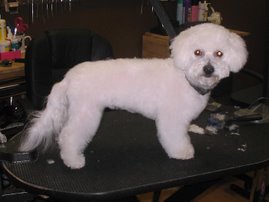
I was planning on writing a post about overall safety or drying techniques but after today I decided to write it on accidents. I was "lucky" today as the accident occurred with my own dog, but it was a reminder to me of how hard it can be when these rare instances happen. For me it was because I was rushing. I was in a hurry to groom my dog and get to my mom's house to pick up my children. I had already groomed all the clients' dogs and was hoping to get out before six o'clock. First mistake of course. I was scissoring away and grazed the bottom of her ear. She didn't flinch or even cry and I didn't even realize I had done it until it started bleeding. My stomach churned and I had to have someone else come look at it. With clients I am okay tending to an injury, but with my own, my stomach can't handle it. So she was cleaned up, we put some liquid bandage on it and she was fine.
Unfortunately accidents happen. They shouldn't happen often and if they are you need to re-access how you are handling the pets in your care. The last time I had a serious accident, and I consider serious requiring vet care, was about 5 years ago. I have nicked a dog or two in the 12 years I've been grooming, but I would probably say no more than 1, maybe 2 occurrences a year, and usually on a severely matted dog or cat. In the 12 years I have also never had a client get irate or even loud with me when an accident has occurred, so I think the manner I handle these rare instances works well.
My first rule has always been to be honest and up front about what has happened. Depending on the circumstance I may stop all grooming and immediately call the owner or I may finish and call the owner as soon as the dog is done to let them know what has happened. I always try to get a hold of them on the phone before they come in. I have found that in most cases I am more upset than the owner. Don't downplay something to avoid responsibility. Be upfront and apologetic. Be sincere. Nothing is worse, to me, than a groomer acting as if what has happened is okay or part of the norm. One of my personal peeves.
My second rule is to take financial responsibility for any vet bill that they may incur. Depending on what has happened I may also give a discount on the groom. (If it's due to the dog being in terrible condition than I normally don't take any money off and I have had them sign a release ahead of time stating they are aware there is a higher risk of nicks and skin irritations). If the client at the time tells me that they feel a visit to the vet is unnecessary I do tell them if they change their mind to call me. I will pay a vet bill within a reasonable amount of time from the grooming incident with documentation from the vet.
My third rule is always do a follow up call. I always call within a week to make sure everything is okay, that the client realizes how terrible I feel for the accident, and that I truly care about their pet. I don't want them to think I have forgotten about them or their precious pet.
Following these 3 rules I have never lost a client. I find that taking responsibility is the key to keeping a client from getting angry. They don't want to hear excuses. Once a client knows that I will be honest and take responsibility I think they feel more comfortable with me. I know that may sound silly, but I think most people understand these are not statues we are working on. Most understand that accidents can happen. When given the option they would rather leave their pet with someone who will be honest about their pets care. Making a follow up call further demonstrates your dedication and concern for their pet. People like knowing they haven't been forgotten.
I am hoping that no one ever has to use these tips, but in the even an accident does occur I hope that these 3 rules can help deflate what can potentially be an emotionally volatile situation.
Friday, April 27, 2007


Wednesday, April 25, 2007
Release Forms
Have you ever had a client come to pick up their dog and exclaim "that's not what I wanted?" even though you did exactly what the owner requested? Or perhaps a client who decides they have forgotten your policy on flea control, pricing, dematting or other issues you clearly went over with them before they left your salon? There is an easy and simply solution that can solve these rare, but problematic clients. Grooming release forms.
Every salon has it's own policy about different things so no two release forms will be identical. The important part is having one that is clearly written, understood and signed by your clients every time they drop their pet off for grooming. The release forms I have used in the past have the paracite policy stating if fleas/ticks are found I will treat the animal at the owners expense. I know there are some pet stylists that don't allow pets with fleas in their salons. If this is the case it should be in your release form, as well as the steps you will take should fleas or other parasites be found. Besides the standard practices that I put on my release forms I also include an area to write down the requested grooming of the pet for that day. If I have, for example, "Buffy" the poodle coming in for a grooming and the owner has requested about a half inch on the body, shaved face but natural feet I would notate it on the form as #2 lamb, c/f (For me that means to use a #2 comb, leave the legs a bit fuller, scissor them in and do a clean face. Every groomer seems to have their own unique abbreviations for things) and then I would also write out "1/2 inch body, fuller legs, clean shaven face" so that the owner can understand what they are agreeing to. I also like to include a price estimate after going over the pet and the clip desired with a notation stating that it is indeed an estimate and if the I find the price will differ by more than $10.00 I will contact the owner first before proceeding (unless it falls under the aforementioned parasite policy). This can be a separate sentence with a "yes" or "no" written next to it. If they check yes then you need to call if the price will be more than the estimated price by $10.00. If they check "no" than you would not need to call to ask beforehand. You can also have a separate note below that stating something simple like "In case of severe matting I give the groomer permission to shave as needed". This will save you time if you later find the pet to be in worse condition than previously thought. Nothing is more frustrating than having a dog on your table, finding it needs to be stripped down and not being able to get a hold of the owner.
These release forms I also use as receipts for the clients. You can easily have them printed up as a carbon copy form if you would like to be able to give your clients a copy of what they have signed. That may cost more but if it's within your budget I would advise it.
The other releases that I always like to have on hand are for vet care. If you use client cards there are many that come preprinted with a release stating if anything should happen to the pet you as the groomer have permission to seek veterinary assistance. If your files are contained on a computer I would include the vet release in with the flea policy. Within the vet release I would also include the name of the veterinary hospital you will be using.
There are other release forms I have seen successfully used. If you tend to groom a lot of senior pets or do a lot of matted pets then I would also recommend a separate senior and matted pet release form. Within the body of the senior pet release I would include that all senior pets are groomed as they will allow. If the pet seems not to be tolerating grooming well grooming will cease and that the grooming will consist only of what the pet can handle. Clean and comfortable is the key for those special seniors out there. The matted coat release form should state that a matted or severely knotted coat can cause skin irritations, that nicks are a greater risk, and that the groomer will do what is in the best interest of the pet. The stylist should not be held liable if skin irritations or nicks occur.
The release forms not only protect you and your business they also can help the client to understand exactly what they are asking for. It may take a few more minutes of your time, but the time you spend having the client read and sign your form is well spent versus the time trying to calm an upset client and business lost because of an unhappy one.
Tuesday, April 24, 2007
The Groomers Image
In today's industry with it's ever changing tools of the trade the one thing that seems to be lagging behind is the image of the typical groomer. Too many clients seem to minimize the amount of knowledge, talent, and overall skill it takes to be an excellent groomer or stylist. The good news is we can do something to change how we as an industry is perceived. We can do a few simple things that will greatly affect the way your clients see you.
How do you talk about your business? Do you call it a shop or salon? Just the term "shop" seems to imply some sort of factory, assembly line type business where "salon" creates a mental image of luxury, pampering and relaxation. Do you introduce yourself as a dog groomer or pet stylist? Though I feel pet stylist exhibits more of a "spa" type image I think the most important thing about the title we give ourselves is how we use it. Do you introduce your profession with pride and exhuberance? You should! We as pet care professionals provide an essential element to a dog or cat's overall health and well being.
Look around your work space. Think to yourself "If I was seeing this space for the first time what impressions would I take away?". Is your area clean and well kept? Are there odors when you first walk through the door every morning that are unpleasant? Is the client area inviting? It doesn't have to cost a lot of money to make a pet salon more professional looking and smelling. Wet dog need not be the only odor a client is greeted with. Keeping your salon clean, having a standard cleaning routine that is followed everyday, using scented candles or some of the automatic air fresheners can all help to convey a warm and inviting but also professional salon. You don't need to have an interior decorator come to redesign your work space or have the most expensive equipment, but you must have a clean well kept area if you expect your clients to treat you as the professional you are. A fresh coat of paint can do wonders for a space and color can be a wonderful way to convey the atmosphere you are wanting to create.
Another area we as groomers need to be mindful of is what we look like when we go to work. I admit to not putting on much make-up myself. I know it will quickly dissolve either by the first wet shaking dog or the first wet kisses of the day, but wearing a clean smock/work shirt, having your hair neatly done and simply looking well put together for the day says a lot about you and what you do. I may look like a wreck at the end of a very long day, but when the owners have dropped off their pets in the morning they are greeted by a neatly dressed, well groomed (no pun intended!) woman with a warm smile.
The final area that we as professionals can affect is the education we pass on to our clients. First we need to educate ourselves, stay up to date and make sure our information is correct. Then we need to pass along in an articulate manner the information to our clients. It's sometimes hard not to sound condescending to an owner who is simply clueless about proper care for their pet. When you hear a client say something like "Well our puppy was peeing all over the house so we took his water away." many of us may want to try to verbally shake some sense into the person. As professionals we have to watch our tone as well as our body language when we speak to clients. We want them to listen and if they feel we are reprimanding them or talking down to them they are more likely not to listen, not to come back, and to tell their friends and neighbors not to frequent our salons. So when someone makes a statement like taking water away from a puppy what could you say? One of the best ways to start a sentence is "I can understand why you might..." It conveys sympathy and understanding without being condescending. So you might say "I can understand why you might think that taking water away from your puppy would help in housebreaking but it is essential to their health to have a constant water supply. I can certainly help you with some housebreaking tips. Have you considered... [crate training]?" This response elicits a more positive reaction from the owner and a more respectful one as well. We want to be respected not only for what we do for their pet but for our knowledge and what we can teach out clients.
In such a few simple steps we change the image of a person who simply cuts dog hair all day to an educated pet professional who is intracate to the overall health and well being of the pets within our care.
Subscribe to:
Posts (Atom)